
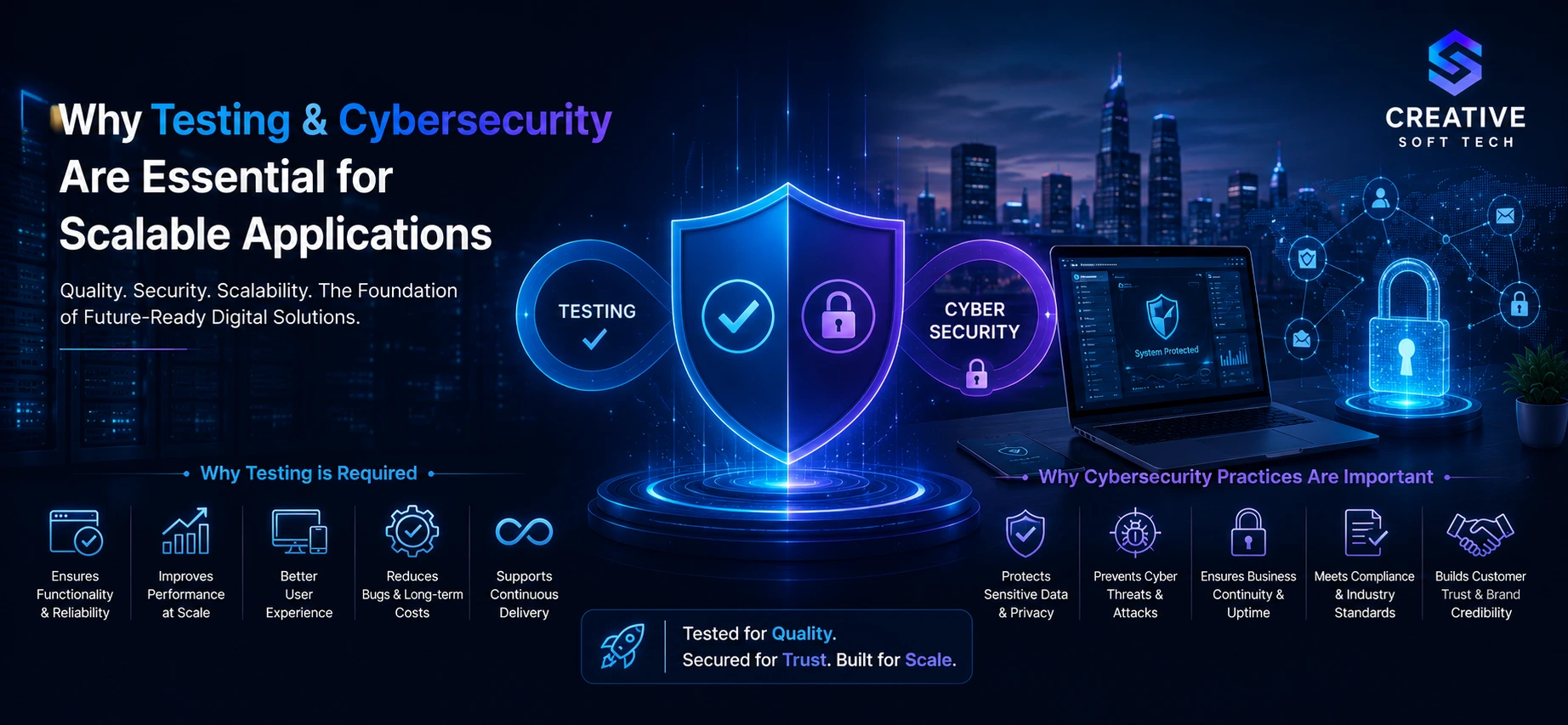
In today’s digital-first world, building a scalable application is no longer just about creating attractive interfaces or adding advanced features. Modern businesses need applications that are reliable, secure, high-performing, and capable of handling growth without failure.
As companies rapidly adopt cloud technologies, AI-powered systems, mobile platforms, and global digital services, two critical pillars determine the long-term success of any application:
- Software Testing
- Cybersecurity Practices
Ignoring either of these can lead to downtime, security breaches, poor customer experience, financial loss, and damaged brand reputation.
At Creative Soft Tech, scalable application development is approached with a strong focus on quality assurance and security-first engineering to ensure businesses can grow confidently in the modern digital ecosystem.
The Growing Need for Scalable Applications
Modern applications are expected to support:
- Thousands of users simultaneously
- Real-time interactions
- Cloud infrastructure
- Cross-platform accessibility
- Continuous updates
- Secure data transactions
- High-speed performance
Whether it’s an e-commerce platform, SaaS product, enterprise dashboard, or mobile application, scalability determines how effectively an application can grow alongside the business.
But scalability without reliability and security creates risk.
That’s why testing and cybersecurity are no longer optional — they are foundational requirements.
Why Software Testing is Critical for Scalable Applications
Software testing ensures that applications function correctly under different conditions before reaching end users.
Without proper testing:
- Bugs enter production
- Features break unexpectedly
- Applications crash during high traffic
- Performance issues appear
- Customer trust decreases
A scalable application must remain stable even as user demand increases.
1. Ensures Stability Under Heavy Traffic
As businesses grow, applications experience higher loads and more concurrent users.
Performance testing helps identify:
- Server bottlenecks
- Slow database queries
- API failures
- Memory leaks
- Infrastructure limitations
This allows developers to optimize the system before real users experience problems.
2. Improves User Experience
Users expect applications to work smoothly across all devices and platforms.
Testing helps ensure:
- Fast loading times
- Responsive interfaces
- Smooth navigation
- Error-free workflows
- Mobile compatibility
A poor user experience often results in customer drop-offs and lost revenue.
3. Reduces Long-Term Development Costs
Fixing issues after deployment is significantly more expensive than identifying them during development.
Early-stage testing:
- Prevents major production failures
- Reduces maintenance costs
- Minimizes downtime
- Improves deployment confidence
This creates a more sustainable and scalable development process.
4. Supports Continuous Deployment
Modern applications are updated frequently with new features and improvements.
Automated testing enables:
- Faster releases
- Safer deployments
- Continuous integration workflows
- Reliable software updates
This is especially important for agile and AI-driven development environments.
Types of Testing Required for Modern Applications
Scalable applications require multiple layers of testing to ensure reliability.
Functional Testing: Verifies that features work according to business requirements.
Performance Testing: Measures application speed, responsiveness, and stability under load.
Load Testing: Checks how the application behaves during high user traffic.
Security Testing: Identifies vulnerabilities and weak points in the system.
UI/UX Testing: Ensures consistent user experience across devices and browsers.
API Testing: Validates backend communication and third-party integrations.
Automated Testing: Speeds up repetitive testing processes and improves development efficiency.
Why Cybersecurity Practices Are More Important Than Ever
As digital transformation accelerates, cyber threats continue to evolve rapidly.
Businesses today face:
- Data breaches
- Ransomware attacks
- Phishing attempts
- API vulnerabilities
- Cloud security risks
- Unauthorized access
- Financial fraud
A single security breach can result in:
- Massive financial loss
- Legal consequences
- Loss of customer trust
- Reputation damage
- Business disruption
Cybersecurity is now a business necessity — not just an IT concern.
The Importance of Cybersecurity in Scalable Application Development
1. Protecting Sensitive Customer Data
Applications often handle:
- Personal information
- Payment details
- Business records
- Authentication credentials
Strong security measures protect this data from unauthorized access and cyberattacks.
2. Preventing Downtime and Service Disruption
Cyberattacks can shut down applications and business operations.
Security-focused development reduces the risk of:
- Server compromises
- Malware infections
- Distributed denial-of-service (DDoS) attacks
- Infrastructure failures
3. Building Customer Trust
Customers are more likely to trust businesses that prioritize security.
Secure applications improve:
- Brand credibility
- Customer retention
- User confidence
- Long-term business relationships
4. Compliance with Industry Standards
Many industries require strict data protection practices.
Cybersecurity helps businesses comply with:
- GDPR
- PCI DSS
- HIPAA
- ISO security standards
- Data privacy regulations
Essential Cybersecurity Practices for Modern Applications
Secure Authentication Systems: Using multi-factor authentication and strong password encryption.
Data Encryption: Protecting sensitive information during storage and transmission.
Regular Security Audits: Identifying vulnerabilities before attackers exploit them.
Secure API Development: Preventing unauthorized access to backend services.
Role-Based Access Control: Limiting user permissions based on responsibilities.
Cloud Security Monitoring: Protecting cloud-hosted infrastructure and databases.
Continuous Security Updates: Keeping frameworks, plugins, and systems updated against emerging threats.
How Testing and Cybersecurity Work Together: Testing and cybersecurity are deeply connected.
A truly scalable application requires:
- Stable architecture
- Reliable performance
- Secure infrastructure
- Continuous monitoring
- Automated quality assurance
Combining both practices ensures:
- Better uptime
- Improved customer experience
- Faster scaling capabilities
- Reduced operational risks
- Long-term business sustainability
How Creative Soft Tech Builds Scalable and Secure Applications
At Creative Soft Tech, development goes beyond coding.
The company focuses on:
- Performance-driven application architecture
- Advanced software testing strategies
- Security-first development practices
- Cloud scalability
- Modern DevOps workflows
- AI-enhanced development processes
With 10+ years of industry-level experience, Creative Soft Tech helps businesses create applications that are:
- Fast
- Reliable
- Scalable
- Secure
- Future-ready
Final Thoughts
In 2026 and beyond, scalable applications must be built with both quality and security at their core.
Software testing ensures applications perform reliably as businesses grow. Cybersecurity practices protect systems, users, and sensitive data from increasingly sophisticated threats.
Together, they create the foundation for modern digital success.
Businesses that invest in secure and thoroughly tested applications are better prepared for growth, customer trust, and long-term digital transformation.
Because in today’s competitive digital world, performance alone is not enough — security and reliability define the future.